An electronic signature is the digital equivalent of a handwritten signature — it captures a person's consent to be bound by the content of a document.
E-signatures are legally recognized in most countries, but the rules vary by region. In the EU, the reference framework is eIDAS, which defines three signature levels with increasing security and legal weight.
The eIDAS framework
eIDAS creates a common standard for e-signatures across all EU member states. It distinguishes three levels — SES, AES and QES — based on how securely the signer's identity is verified. Most providers can offer SES and AES without formal accreditation. QES, however, requires the provider to be certified as a Qualified Trust Service Provider (QTSP) by a national authority (e.g. ANSSI in France).
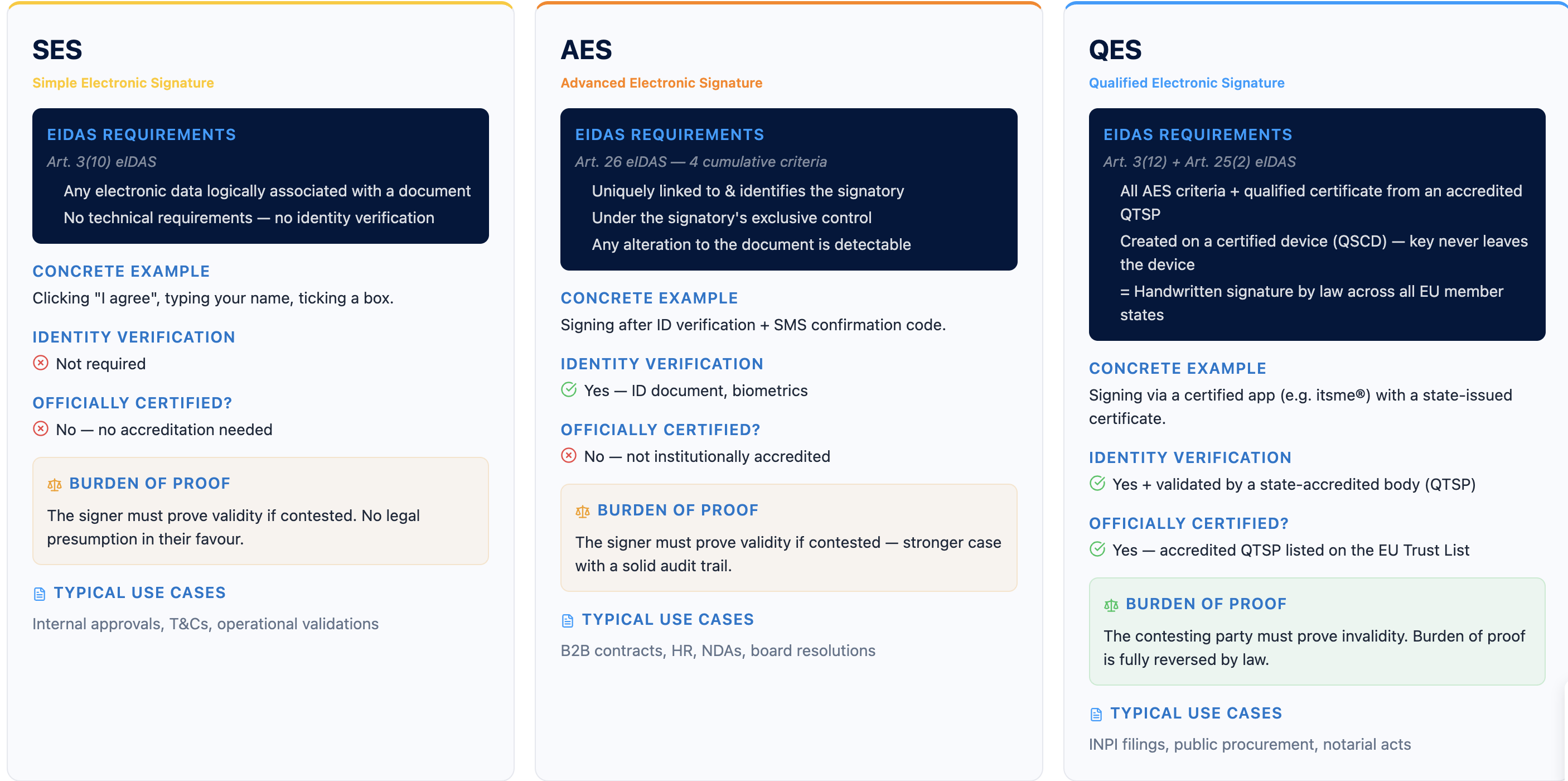
Market ambiguity: The terms SES, AES and QES are frequently misused by providers — including well-known ones. Only QES is officially certified. AES is a technical standard, not an accreditation. Never promise "full eIDAS compliance" without specifying the level and context of use.
✨ E-signature around the world
Electronic signatures are legally recognized globally, but frameworks vary by region. Here is an overview of the main standards outside the EU.
| Region / Country | Framework | SES / AES / QES classification? | Key notes |
|---|---|---|---|
| United States | ESIGN Act (2000) + UETA | ❌ No | Any e-signature is generally valid. Burden of proof falls on whoever challenges it. Some states have stricter rules for specific document types (wills, real estate). |
| United Kingdom | UK eIDAS | ✅ Yes (SES / AES / QES) | Post-Brexit equivalent of EU eIDAS. EU eIDAS signatures are generally recognized in the UK and vice versa. |
| Switzerland | ZertES | ✅ Yes (equivalent levels) | Closely mirrors eIDAS. QES under ZertES has the same legal force as a handwritten signature under Swiss law. |
| Canada | PIPEDA + provincial laws | ❌ No | Legal validity depends on context and ability to identify the signatory. Most provinces have UETA-equivalent legislation. |
| Australia | Electronic Transactions Act (1999) | ❌ No | Broad recognition. Validity depends on reliability of the method used and intent of the signatory. |
| Japan | Act on Electronic Signatures (2001) | ❌ No | Valid if the signature identifies the signatory and confirms document integrity. |
| Singapore | Electronic Transactions Act | ❌ No | Broadly aligned with international standards. |
| China | Electronic Signature Law (2005) | ❌ No | Valid signatures must be uniquely linked to the signatory and under their exclusive control. |
| UAE | Federal Decree-Law No. 46 (2021) | ❌ No | E-signatures recognized broadly. Some document types (real estate, family law) require wet ink or notarization. |
⚠️ What this means for DiliTrust users: DiliTrust's e-signature framework is built around eIDAS, which covers EU, UK and Swiss contexts. For clients operating in other regions, the legal validity of a signature depends on local law — consult your legal team to confirm which signature level is appropriate for your jurisdiction and document type.
Electronic signatures are a legal tool — choosing the right level for each document ensures your agreements are enforceable, wherever you do business. ✨
Was this article helpful?
That’s Great!
Thank you for your feedback
Sorry! We couldn't be helpful
Thank you for your feedback
Feedback sent
We appreciate your effort and will try to fix the article